


 Tanuja Kathait



What Is Precision Farming? Ultimate Guide for Agriculture Students (2026)
 Swati Raj
May 19, 2026
Swati Raj
May 19, 2026 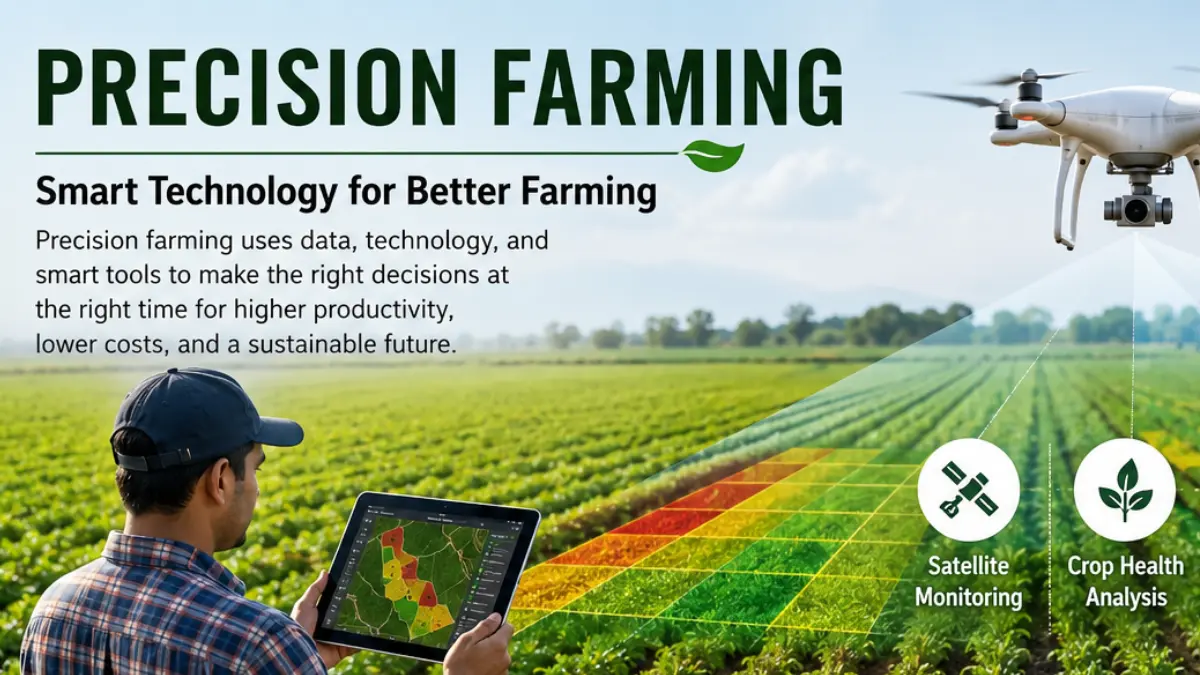
Agriculture is changing rapidly. Earlier, farmers depended mainly on traditional methods, experience, and guesswork to grow crops. Today, technology is transforming farming into a smarter and more efficient process. One of the biggest innovations leading this transformation is precision farming.
But what exactly is precision farming, and why is everyone talking about it?
Imagine a farmer who knows exactly how much water a crop needs, which area of the field lacks nutrients, and where pests are attacking — all before major damage happens. Sounds futuristic, right? This is exactly what precision farming helps achieve.
In simple words, it uses modern technology to improve crop production while reducing waste. It helps farmers make better decisions using data, sensors, GPS, drones, and smart devices.
For agriculture students, understanding precision farming is becoming increasingly important because modern agriculture jobs now require knowledge of technology-based farming systems.
In this guide, we will explore everything about precision farming, its technologies, benefits, challenges, examples, and future scope in agriculture.
What Is Precision Farming?
Precision farming is a modern farming approach that uses technology and data to monitor and manage crops more accurately.
Instead of treating an entire field the same way, precision farming focuses on understanding the exact needs of different parts of the field.
For example:
A farmer may notice that one section of the field needs more fertilizer, while another section already has enough nutrients.
Instead of wasting resources everywhere, farmers apply inputs only where needed.
This improves productivity and reduces costs.
In simple terms:
Precision farming means “doing the right farming activity at the right place and at the right time.”
This method is also known as precision agriculture, and it is becoming popular worldwide.
Why Precision Farming Is Important
Modern agriculture faces several challenges such as:
- Climate change
- Water shortages
- Rising fertilizer costs
- Pest attacks
- Soil degradation
- Increasing food demand
Traditional farming methods often waste resources.
For example:
A farmer may irrigate the entire farm equally, even when some areas do not need water.
This causes:
- Water wastage
- Higher costs
- Reduced efficiency
However, precision agriculture solves this problem by using real-time information.
As a result, farmers can:
- Save money
- Improve productivity
- Use fewer chemicals
- Protect the environment
This makes precision farming one of the most important developments in modern agriculture.
How Does Precision Farming Work?
Many students wonder:
“How can technology actually help farming?”
The answer lies in data collection.
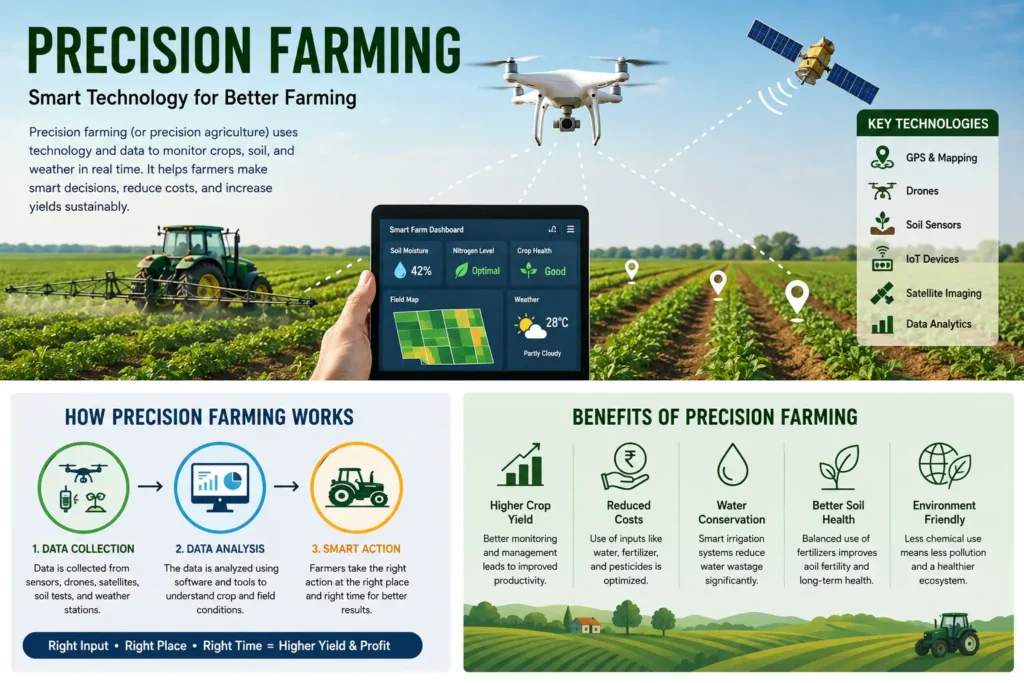
Precision farming works through three simple steps:
1. Data Collection
Farmers collect information about:
- Soil condition
- Moisture level
- Crop health
- Weather conditions
- Pest activity
This data is gathered through sensors, satellites, drones, and smart farming tools.
2. Data Analysis
After collecting information, software systems analyze the data.
For example:
If soil moisture is low in one area, the system suggests irrigation.
Similarly, nutrient deficiencies can also be identified.
3. Smart Action
Based on the analysis, farmers take better actions.
For example:
Instead of spraying pesticides everywhere, they only treat affected areas.
As a result, farming becomes more efficient.
Major Precision Farming Technologies
Technology is the backbone of precision farming.
Let us understand the most important precision farming technologies used today.
1. GPS Technology in Agriculture
GPS (Global Positioning System) helps farmers understand field locations accurately.
With GPS, farmers can:
- Map farm boundaries
- Monitor crop performance
- Track machinery
This improves accuracy in farming activities.
For instance, tractors equipped with GPS can follow exact paths, reducing overlaps and wastage.
2. Drones in Precision Farming
Drones have become one of the most exciting innovations in agriculture.
Farmers use drones for:
- Crop monitoring
- Pest detection
- Fertilizer spraying
- Field mapping
Drones can quickly identify crop stress and damaged areas. As a result, farmers can take immediate action.
3. Soil Sensors
Soil sensors help farmers understand:
- Moisture levels
- Soil fertility
- Nutrient availability
Instead of guessing, farmers receive real data. This improves fertilizer and irrigation management.
4. IoT (Internet of Things) in Agriculture
IoT devices connect farming equipment through the internet.
For example:
Smart irrigation systems automatically provide water when needed. This helps save both time and water.
5. Satellite Imaging
Satellite technology helps monitor:
- Crop growth
- Vegetation health
- Weather patterns
Farmers can observe large areas without physically visiting every field.
Why Agriculture Students Should Learn Precision Farming
Many students think:
“I only need traditional agriculture knowledge.”
But that is changing.
Companies today prefer candidates who understand:
- Farm technologies
- Digital agriculture
- Smart irrigation
- Precision farming systems
Students with these skills often get better opportunities in:
- Agritech startups
- Research organizations
- Agricultural consulting
- Farm technology companies
Therefore, learning precision farming can give students a strong career advantage.
How Students Can Learn Precision Farming
Interested in learning?
Here are some ways:
- Online Courses: Many platforms offer agriculture technology programs.
- Agricultural Workshops: Attend seminars and workshops.
- Internships: Join agritech companies for practical exposure.
- YouTube & Educational Platforms
Watch videos on:
- Drones in agriculture
- GPS farming
- Smart irrigation
Benefits of Precision Farming
Now let us discuss the major benefits of precision farming.
1. Better Crop Yield
Precision farming helps improve productivity.
Farmers understand exactly what crops need.
As a result, plants grow healthier and produce better yields.
2. Reduced Cost of Farming
Traditional farming sometimes wastes:
- Fertilizers
- Water
- Seeds
- Pesticides
However, precision farming reduces unnecessary use.
This lowers farming expenses.
3. Water Conservation
Water scarcity is becoming a serious problem.
Precision farming uses smart irrigation systems.
As a result, only necessary areas receive water.
This saves a significant amount of water.
4. Better Pest Management
Pests can damage crops quickly.
With drones and sensors, farmers identify problems early.
Therefore, pest control becomes faster and more effective.
5. Environment Protection
Excessive chemical use harms soil and water.
Precision farming reduces overuse of chemicals.
As a result, farming becomes more sustainable.
6. Improved Soil Health
Healthy soil means healthy crops.
Through data monitoring, farmers understand nutrient deficiencies.
Consequently, they apply fertilizers more effectively.
Difference Between Traditional Farming and Precision Farming
Traditional Farming | Precision Farming |
Based on guesswork | Based on data |
Same treatment for all fields | Customized treatment |
Higher wastage | Efficient resource use |
Less technology | High technology use |
Lower accuracy | Better accuracy |
This comparison clearly shows why modern farming is moving toward precision methods.
Real-Life Examples of Precision Farming
Example 1: Smart Irrigation
Some farmers use moisture sensors.
When soil becomes dry, irrigation starts automatically.
This saves water and labor.
Example 2: Drone Crop Monitoring
Farmers use drones to identify pest-infected areas.
Instead of spraying chemicals everywhere, only affected parts are treated.
Example 3: Fertilizer Management
GPS-based systems help farmers apply fertilizers more accurately.
This improves efficiency and lowers costs.
Challenges of Precision Farming
Although precision farming has many advantages, it also has some challenges.
- High Initial Cost
Modern equipment can be expensive.
Small farmers may struggle to afford technologies like drones and sensors.
- Lack of Technical Knowledge
Many farmers still do not understand digital technologies.
Training becomes important.
- Internet Connectivity Issues
Rural areas may have poor internet access.
This affects smart farming systems.
- Data Management Problems
Collecting data is easy.
However, understanding and using it properly can be difficult.
Future Scope of Precision Farming
The future of precision agriculture looks very promising.
Why?
Because agriculture is becoming more technology-driven every year.
In the future, we may see:
- AI-based farming systems
- Smart robots in agriculture
- Automated machinery
- Better drone technology
- Climate-smart farming
India is also promoting digital agriculture initiatives. As a result, demand for agriculture professionals with technical knowledge will increase.
Follow Us on these social media platforms to stay updated:
About the Author




1 thought on “What Is Precision Farming? Ultimate Guide for Agriculture Students (2026)”