


 Swati Raj
 Tanuja Kathait


 agriyuvaa
One common question every students asks after completing 12 that “Which agriculture entrance exam should I prepare for?”
Every year, thousands of students complete Class 12 and start searching for the right career path. Some dream of becoming doctors, engineers, or civil servants. However, a growing number of students are now choosing agriculture as a career.
Why? Because agriculture is no longer limited to farming. Today, it offers opportunities in technology, research, government jobs, agribusiness, banking, and entrepreneurship. Yet many students face one major challenge. They know they want to study agriculture, but they do not know where to start. Questions such as:
- Which agriculture entrance exam should I prepare for?
- Is there a separate BSc Agriculture entrance exam?
- Which colleges accept agriculture entrance exam scores?
- How difficult are these exams? often create confusion.
If you are facing the same questions, this guide is for you. Instead of simply listing exams and eligibility criteria, this article will help you understand the complete journey—from being a Class 12 student to securing admission in a reputed agriculture college.
Why More Students Are Choosing Agriculture Than Ever Before
A decade ago, agriculture was often seen as a traditional career choice. Today, the situation has changed completely. Modern agriculture involves:
- Artificial Intelligence
- Drone Technology
- Precision Farming
- Agri-tech Startups
- Climate-Smart Agriculture
- Data-Driven Farming
As a result, the agriculture sector now requires skilled professionals who can combine science, technology, and practical farming knowledge. This growing demand has increased interest in agriculture courses across India. Consequently, competition for agriculture admissions has also increased. This is where the Agriculture Entrance Exam becomes important.
What is an Agriculture Entrance Exam?
An Agriculture Entrance Exam is a test conducted by universities, state authorities, or national agencies to select students for agriculture degree programs. The purpose is simple.
Colleges want to identify students who have a strong understanding of science subjects and are capable of succeeding in agricultural education.
Most entrance exams evaluate knowledge in:
- Physics
- Chemistry
- Biology
- Mathematics
- Agriculture-related concepts (in some exams)
A good score can help students secure admission to top agricultural universities.
The Biggest Mistake Students Make Before Preparing
Many students immediately start studying random books. Unfortunately, this is one of the biggest mistakes.
Before beginning preparation, students should first answer a simple question: Which agriculture entrance exam am I targeting? Different institutions follow different admission systems.
For example: Some universities use national-level exams. Others conduct state-level admissions. Meanwhile, certain private institutions have their own admission process. Therefore, understanding the exam pathway should always come before preparation.
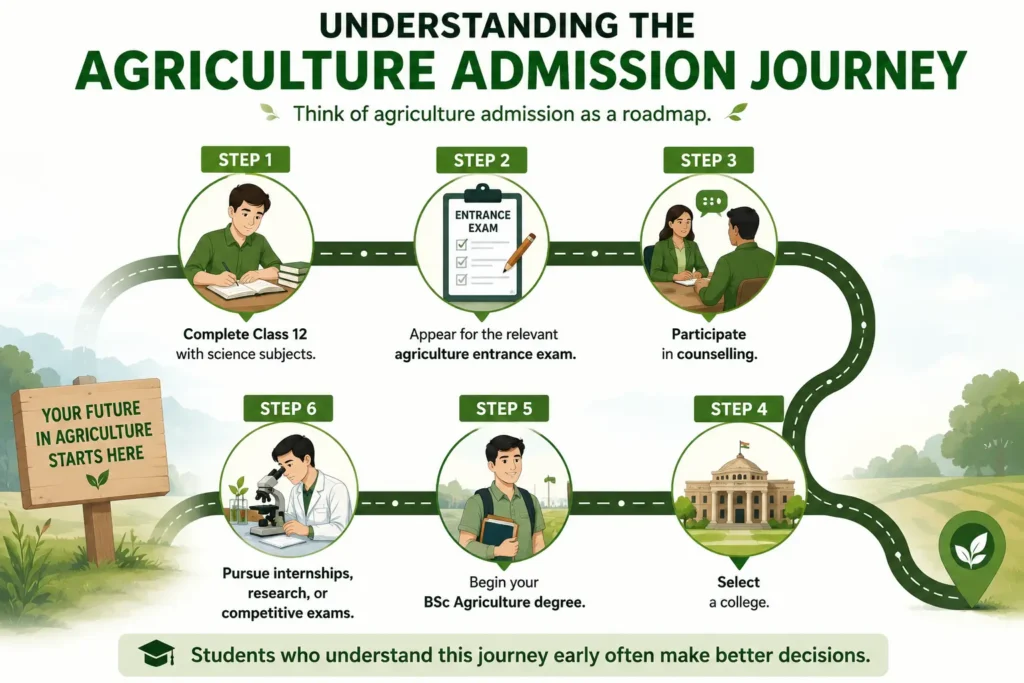
Understanding the Agriculture Admission Journey
Think of agriculture admission as a roadmap.
Step 1: Complete Class 12 with science subjects.
Step 2: Appear for the relevant agriculture entrance exam.
Step 3: Participate in counselling.
Step 4: Select a college.
Step 5: Begin your BSc Agriculture degree.
Step 6: Pursue internships, research, or competitive exams.
Students who understand this journey early often make better decisions.
Is There a Separate BSc Agriculture Entrance Exam?
This is one of the most common questions among students. The answer is: Not always.
Many institutions use broader agriculture entrance exams for admission into BSc Agriculture programs. Therefore, when students search for a BSc Agriculture Entrance Exam, they are often referring to entrance tests used for admission into agriculture degree courses. The actual exam may differ depending on the university or admission authority.
What Skills Does an Agriculture Student Need?
Many students assume agriculture is only about crops. In reality, successful agriculture professionals possess multiple skills. These include:
- Scientific Thinking: Agriculture involves understanding plant growth, soil health, and environmental factors.
2. Observation Skills: A good agriculture student learns to observe patterns and identify problems.
3. Problem-Solving Ability: Modern farming challenges require innovative solutions.
4. Communication Skills: Agriculture professionals often work directly with farmers, researchers, and organizations. Therefore, communication becomes important.
What Subjects Should You Focus On?
Instead of trying to study everything, students should prioritize core subjects.
- Biology: Biology forms the foundation of agricultural science. Topics related to plant systems, genetics, and ecology are especially important.
2. Chemistry: Agriculture relies heavily on chemistry. Understanding nutrients, fertilizers, and soil reactions becomes easier with a strong chemistry background.
3. Physics: Although many students fear physics, it remains an important part of most entrance exams.
4. Mathematics: Certain universities and admission systems accept mathematics students. Therefore, mathematics preparation may also be beneficial.
A Practical 90-Day Preparation Plan
Many students ask: How should I prepare if my exam is only three months away?
Here is a practical approach.
First 30 Days
Focus on understanding concepts.
Avoid rushing into mock tests immediately.
During this phase:
- Read NCERT thoroughly
- Make short notes
- Identify weak topics
Next 30 Days
Begin practicing questions. This stage should focus on:
- Topic-wise tests
- Previous-year questions
- Time management
Final 30 Days
The final month should be dedicated to revision.
Focus on:
- Mock tests
- Formula revision
- Important concepts
- Mistake analysis
This structured approach usually works better than studying randomly.
What Most Students Ignore During Preparation
Interestingly, many students focus only on textbooks.
However, successful candidates often do something different. They spend time understanding:
- Exam trends
- Question patterns
- Frequently repeated topics
As a result, they prepare more efficiently.
Remember: Studying hard is important. Studying smart is even more important.
A Day in the Life of a BSc Agriculture Student
Many students wonder what happens after admission. A typical agriculture student experiences much more than classroom learning. Activities often include:
- Field visits
- Crop demonstrations
- Soil analysis
- Laboratory practicals
- Farm management exercises
- Research projects
This practical exposure makes agriculture different from many other degree programs. Students learn by doing, not just by reading.
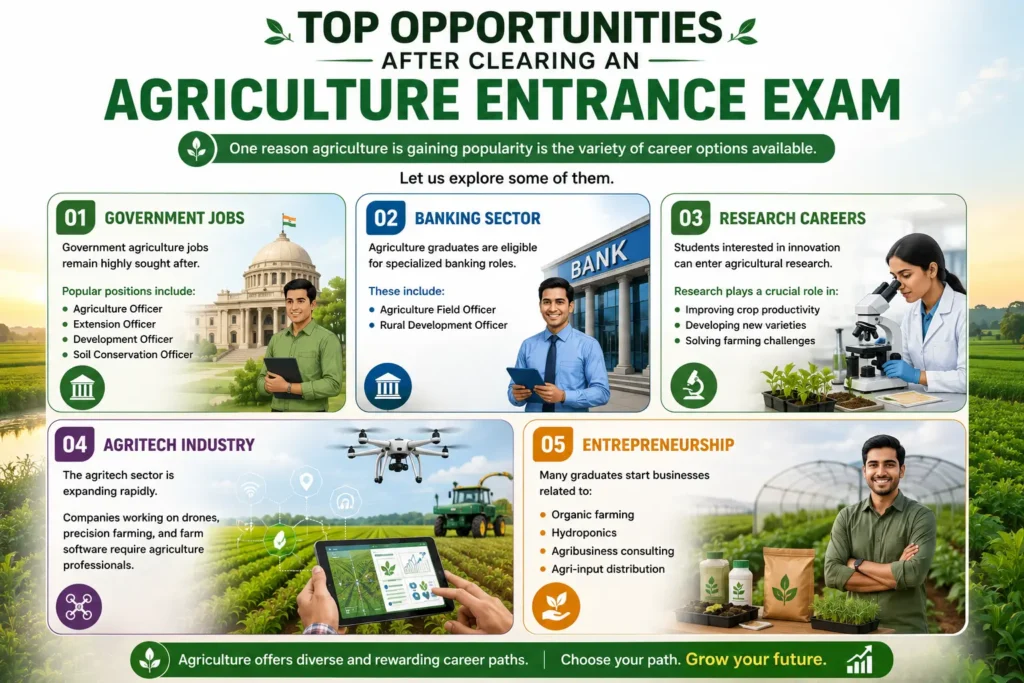
Top Opportunities After Clearing an Agriculture Entrance Exam
One reason agriculture is gaining popularity is the variety of career options available. Let us explore some of them.
- Government Jobs: Government agriculture jobs remain highly sought after. Popular positions include:
- Agriculture Officer
- Extension Officer
- Development Officer
- Soil Conservation Officer
2. Banking Sector : Agriculture graduates are eligible for specialized banking roles. These include:
- Agriculture Field Officer
- Rural Development Officer
3. Research Careers: Students interested in innovation can enter agricultural research. Research plays a crucial role in:
- Improving crop productivity
- Developing new varieties
- Solving farming challenges
4. Agritech Industry: The agritech sector is expanding rapidly. Companies working on drones, precision farming, and farm software require agriculture professionals.
5. Entrepreneurship: Many graduates start businesses related to:
- Organic farming
- Hydroponics
- Agribusiness consulting
- Agri-input distribution
How to Choose the Right Agriculture College
Choosing a college is as important as clearing the exam. While selecting a college, consider:
- Faculty Quality: Good teachers significantly improve learning outcomes.
2. Infrastructure: Look for:
- Laboratories
- Research facilities
- Experimental farms
3. Placement Opportunities: A college with strong industry connections can improve career prospects.
4. Internship Exposure: Practical training matters greatly in agriculture. Therefore, colleges offering field exposure should be preferred.
Common Myths About Agriculture Education
Let us clear some misconceptions.
Myth 1: Agriculture Has Limited Jobs
Reality: Agriculture offers opportunities in government, private, research, and startup sectors.
Myth 2: Agriculture Is Only for Farmers
Reality: Many agriculture students come from non-farming backgrounds.
Myth 3: Agriculture Has Low Salaries
Reality: Several agriculture careers offer competitive salaries and long-term growth.
Myth 4: Technology Is Not Important in Agriculture
Reality: Modern agriculture heavily depends on technology.
Why Agriculture Could Be One of the Most Important Careers of the Future
The world’s population continues to grow. At the same time:
- Climate change is increasing.
- Natural resources are under pressure.
- Food demand is rising.
These challenges require skilled agricultural professionals. Future agriculture will depend on:
- Smart farming
- Sustainable production
- Data-driven decision making
- Scientific innovation
Students entering agriculture today will play a crucial role in solving tomorrow’s food challenges.
FAQs
1. What is an Agriculture Entrance Exam?
An Agriculture Entrance Exam is a test conducted for admission into agriculture-related degree programs.
2. Is there a separate BSc Agriculture Entrance Exam?
Some institutions conduct separate exams, while others use common agriculture admission tests.
3. Which subjects are important for agriculture entrance exams?
Physics, Chemistry, Biology, and sometimes Mathematics are the most important subjects.
4. Can PCM students apply for agriculture courses?
Yes, many universities allow students with a mathematics background.
5. How much time is required for preparation?
Most students can prepare effectively within three to six months with a structured study plan.
6. Is agriculture a good career in 2026 and beyond?
Yes. Agriculture offers strong opportunities in government jobs, agri-tech, research, banking, and entrepreneurship.
7. What should I study first?
Start with NCERT textbooks and understand the exam pattern
About the Author